Poor Woodcutter
The Most Precious of CargoesThe Poor Woodcutter’s transformation from a man who rejects an unwanted child into a father who protects her at the cost of his own life gives his story its decisive shape. His change begins in a forest governed by hunger and cold, where hardship narrows the imagined possibilities of family but does not extinguish his wife’s longing for a child.
Identity and Background
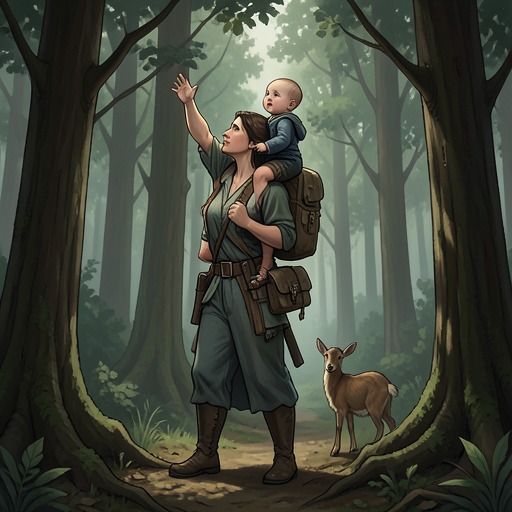
The Poor Woodcutter lives with the Poor Woodcutter’s Wife in a great forest during wartime. They are poor, and hunger is constant; winter brings a cold that presses upon their lives, while summer briefly drives it away. The surrounding war makes the forest’s deprivation part of a wider calamity rather than an isolated misfortune.
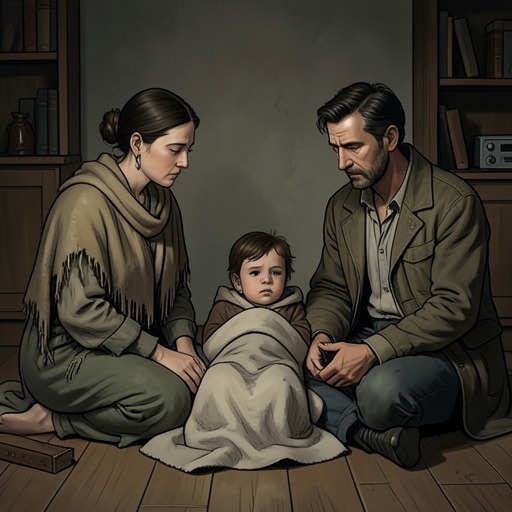
Their childlessness initially means different things to the couple. The Poor Woodcutter thanks heaven that there is no child to feed, treating the absence as a small mercy in a life marked by scarcity. The Poor Woodcutter’s Wife secretly grieves that, although she has no child to feed, she has no child to love. She prays to heaven and to the powers she perceives in the natural world for a child, while also wishing for an end to the hunger and cold that afflict them. This contrast establishes the emotional distance the Poor Woodcutter must cross: what he regards as protection from another burden is, to his wife, the absence of a longed-for bond.
Refusal and Recognition
The Poor Woodcutter’s resistance becomes immediate when he returns from public works and hears the child crying in the cabin. He roars in alarm at the unexpected presence, while the Poor Woodcutter’s Wife answers simply that it is a child. The exchange opens a conflict between his first response to the baby as an unforeseen burden and her determination to treat the child as someone entrusted to her care.
That resistance hardens one night when the girl cries more than usual and the Poor Woodcutter, roused from a doze, raises his hand to strike her. The Poor Woodcutter’s Wife catches his calloused hand in midair and holds it against the child’s chest. He tries to pull away, but she keeps his palm there while he protests that he wants nothing to do with the child. Her answer is not an argument about duty or scarcity: she asks him to feel the tiny heart beating beneath his hand. The scene makes physical contact the turning point. What he has called a cursed creature is, under his own palm, a living and vulnerable child.
The next day, the sensation persists in his attention. Wherever he lays his hand, he feels the girl’s heartbeat against his palm; tenderness, previously unfamiliar to him, begins to take the place of rejection. When he is alone with her, he offers a hesitant finger, which she clutches and will not release. The small, repeated gesture gives their relationship a form before he can fully articulate it: she reaches for him, and he allows himself to be held by that contact.
His change becomes visible when the girl pulls herself upright by gripping the patched knee of his trousers. The Poor Woodcutter calls excitedly for his wife to come and see, then watches the child totter as she tries to balance. When she lets go and falls onto her backside, laughing, he scoops her up and brandishes her in celebration. His delight reverses the earlier scene of his raised hand: the same child he had nearly struck is now the source of his unguarded joy. For the couple, this new attachment briefly makes the forest’s hunger, cold, poverty, and surrounding war feel less oppressive; their shared happiness gathers around the child they have come to call their own.
Protection and Sacrifice
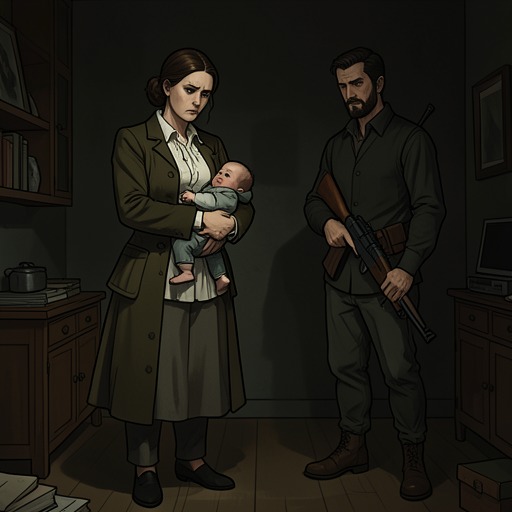
The Poor Woodcutter’s new attachment is tested when the Wood-Alcohol Distiller arrives at the cabin with two militiamen. Presenting one of them as a comrade from the building site, the Poor Woodcutter calls to his wife to ready the child and bring the visitors a drink. But when the Poor Woodcutter’s Wife appears with the girl in her arms, the child reaches toward him, and he takes up his ax and orders his wife to flee with her. His response turns the welcome into a defense: he repeatedly strikes the distiller, then steps outside and fells one of the militiamen.
The remaining militiaman backs away, fires a shot into the air, and then aims at the Poor Woodcutter as he advances with his ax raised. The Poor Woodcutter crumples, but his last words are for his family: he urges his wife to run and save herself, and asks that their daughter live. The change that began with his hand resting against the girl’s heartbeat now governs his final action; he puts himself between her and the men who threaten her.
The Poor Woodcutter’s Wife obeys, carrying the child away and not turning back toward her husband, the cabin he built with his own hands, or the brief happiness they had shared there. His death leaves that happiness behind as something both real and terribly short-lived. In protecting his adopted daughter, he completes the passage from a man who first resisted her presence to a father whose last concern is her survival.
The Turning Point and Fairy-Tale Reversal
The Poor Woodcutter’s first response is not the story’s last word on him. When he tries to take the child away, the Poor Woodcutter’s Wife throws herself between him and the little cargo, insisting that if he casts the child beneath the cargo train, he must cast her there too. She warns that the gods of heaven, earth, sun, and train will pursue and curse him. He stands motionless, then returns the child to his wife. In the handover, the narrative also discloses that the child is a girl, overturning the earlier assumption that she was a boy.
That pause matters: his eventual acceptance follows a confrontation in which his wife refuses to let his authority settle the child’s fate. The story places his change within a relationship, not in isolation. Her fierce defense keeps the girl with them long enough for the Poor Woodcutter to encounter her not as an abstract burden but as a living child whose heartbeat he will feel.
The narrator frames the couple’s story against the familiar fairy-tale premise of parents abandoning children because they cannot feed them, explicitly rejecting that tale as absurd. The Poor Woodcutter initially shares the logic of scarcity: no child means one less mouth to feed. Yet his own arc unsettles that arithmetic. The child does not erase hunger or danger, but she becomes someone he loves and ultimately protects, making his final sacrifice the sharpest reversal of his first refusal.